
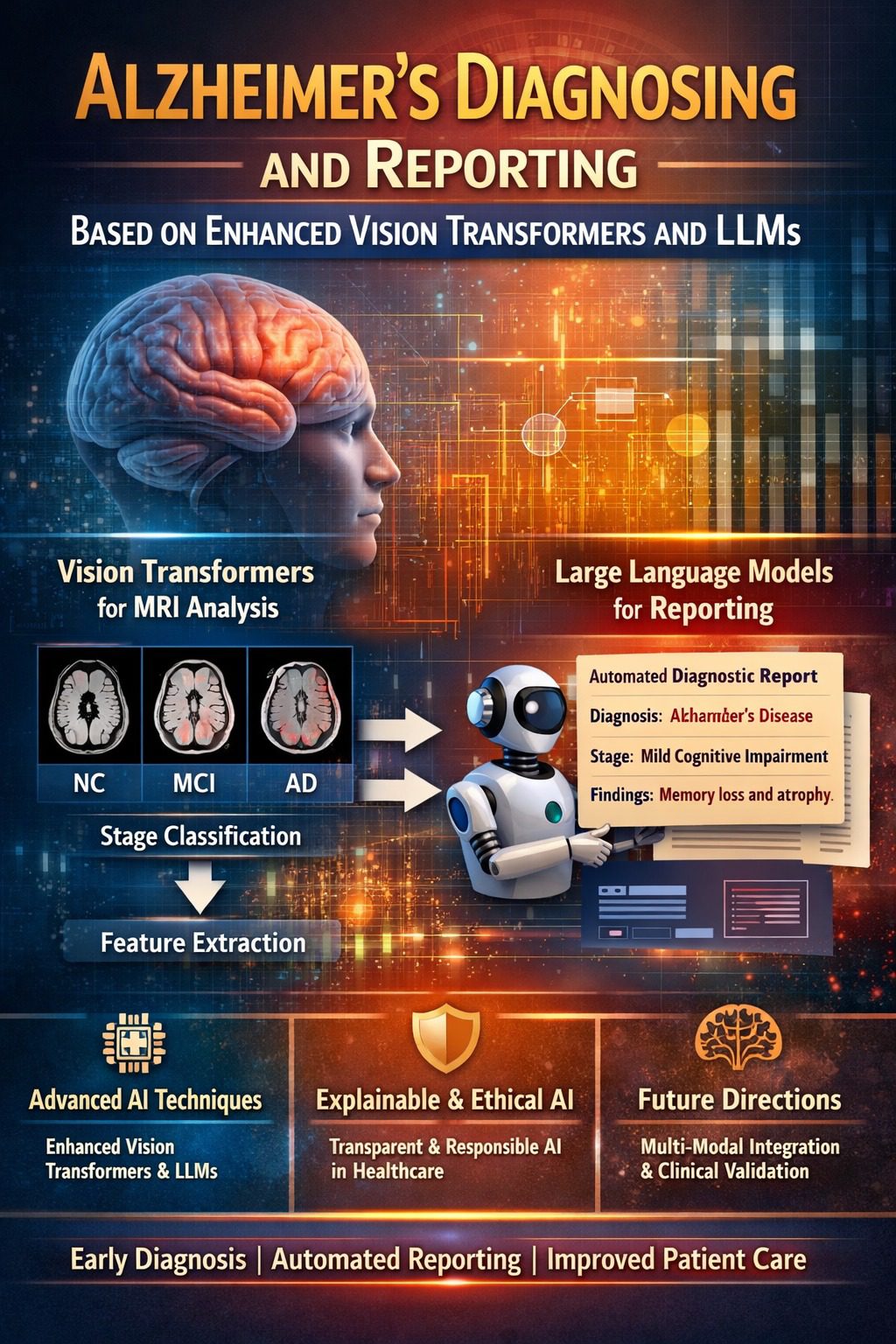
A workshop was conducted to discuss recent advances in artificial intelligence for Alzheimer’s disease diagnosis, focusing on the integration of Enhanced Vision Transformers (ViTs) and Large Language Models (LLMs). The workshop aimed to explore how modern deep learning techniques can improve the accuracy of medical image analysis and automate clinical reporting.
The presented work introduced an AI-based framework that utilizes Vision Transformers for extracting global and discriminative features from brain MRI scans to classify Alzheimer’s disease stages, including Normal Control (NC), Mild Cognitive Impairment (MCI), and Alzheimer’s Disease (AD). In addition, Large Language Models were incorporated to automatically generate clear and clinically meaningful diagnostic reports based on model predictions.
Discussions during the workshop highlighted the advantages of transformer-based architectures over traditional CNN approaches, particularly in capturing long-range dependencies in medical images. Participants also emphasized the importance of explainability, data quality, and ethical considerations when deploying AI systems in healthcare.
The workshop concluded that combining Vision Transformers with LLMs represents a promising direction for early diagnosis, decision support, and clinical efficiency in neurodegenerative disease management. Future work was suggested in the areas of multi-modal data integration, explainable AI, and real-world clinical validation.
Keywords: Workshop, artificial intelligence, Alzheimer’s disease, diagnosis, Enhanced Vision Transformers, ViTs, Large Language Models, LLMs, deep learning techniques, medical image analysis, automate clinical reporting, AI-based framework, extracting features