
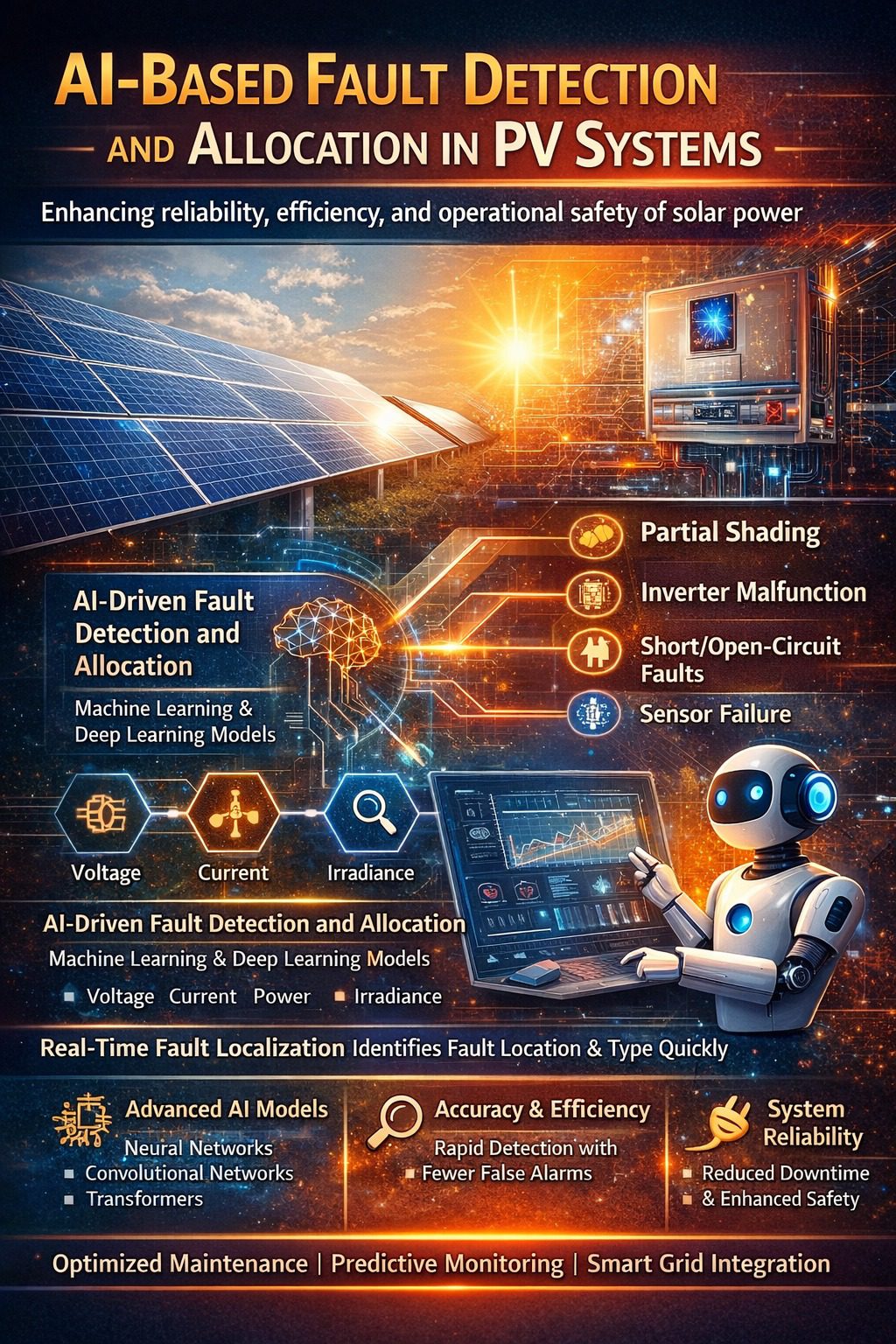
This work focuses on the application of artificial intelligence (AI) techniques for fault detection and allocation in photovoltaic (PV) systems to enhance system reliability, efficiency, and operational safety. PV systems are subject to various faults such as partial shading, inverter malfunctions, short-circuit and open-circuit faults, degradation, and sensor failures, which can significantly reduce power output if not detected early.
The proposed AI-based approach utilizes machine learning and deep learning models to analyze electrical and environmental data, including voltage, current, power, irradiance, and temperature. By learning normal and faulty operating patterns, the system can accurately detect, classify, and localize faults within PV arrays in real time. Advanced models such as neural networks, convolutional architectures, and transformer-based methods improve fault recognition accuracy under varying operating conditions.
The allocation module identifies the fault location and type, enabling rapid maintenance decisions and minimizing system downtime. Compared to conventional threshold-based and rule-based techniques, the AI-driven framework offers higher accuracy, adaptability to changing conditions, and reduced false alarms.
Overall, AI-based fault detection and allocation provide a robust and intelligent solution for monitoring PV systems, supporting predictive maintenance, improving energy yield, and facilitating the integration of renewable energy into smart grids.
Keyword: Artificial intelligence, fault detection, allocation, photovoltaic systems, reliability, efficiency, operational safety, partial shading, inverter malfunctions, short-circuit faults, open-circuit faults, degradation, sensor failures, power output, machine learning